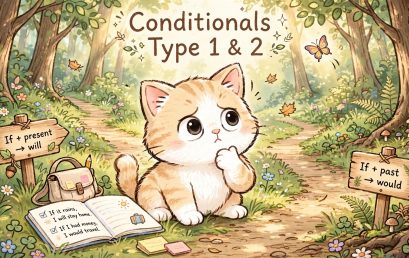
Conditional Sentences Type 1 & 2: Real and Unreal Situations
📚 English Grammar Series — Level 2: Intermediate (Part 4 of 5) “If it rains, I’ll stay home.” Conditional sentences connect a condition to its result — they’re how English expresses cause and effect, plans, dreams, and warnings. Types 1 and 2 handle the two most common situations: real possibilities and imaginary situations. (Type 0 […]

Modal Verbs: Can, Must, Should, Might, and More
📚 English Grammar Series — Level 2: Intermediate (Part 3 of 5) Can, could, must, should, may, might, will, would — modal verbs are the tiny engines of nuance in English: ability, permission, obligation, advice, possibility. One golden rule governs them all: after a modal, always use the base verb — no -s, no -ed, […]
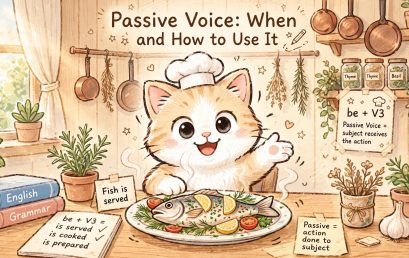
Passive Voice: When and How to Use It
📚 English Grammar Series — Level 2: Intermediate (Part 2 of 5) “Shakespeare wrote Hamlet” vs “Hamlet was written by Shakespeare” — same fact, different spotlight. The passive voice moves the receiver of the action to the front. It’s the voice of news, science, formal writing — and polite excuses. Let’s master every form of […]
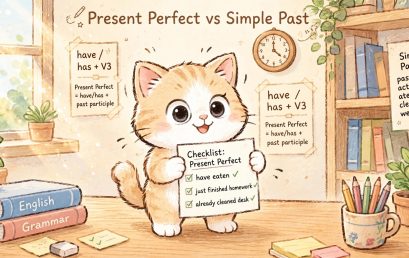
Present Perfect vs Simple Past: What’s the Difference?
📚 English Grammar Series — Level 2: Intermediate (Part 1 of 5) “I have eaten“ vs “I ate“ — both describe the past, so what’s the difference? This pair confuses almost every learner, but the logic is beautifully simple: simple past = finished time, present perfect = connection to now. Let’s break it down completely. […]
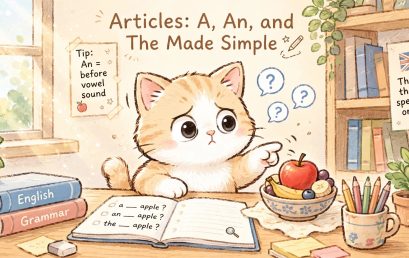
Articles: A, An, and The Made Simple
📚 English Grammar Series — Level 1: Beginner (Part 5 of 5) Three tiny words — a, an, the — cause more mistakes than almost any other grammar point. But there’s a clear logic: it’s all about whether your listener can identify which one you mean. Learn the system below and articles become predictable. 1. […]
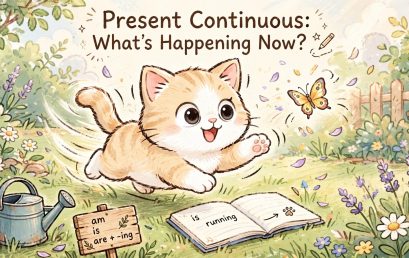
Present Continuous: What’s Happening Now?
📚 English Grammar Series — Level 1: Beginner (Part 4 of 5) What’s happening right now? The present continuous (also called present progressive) is the tense of live action — phone calls, live commentary, temporary situations, and even fixed future plans. Formula first: am/is/are + verb-ing. 1. Spelling Rules for Verb-ing Rule Example Most verbs […]
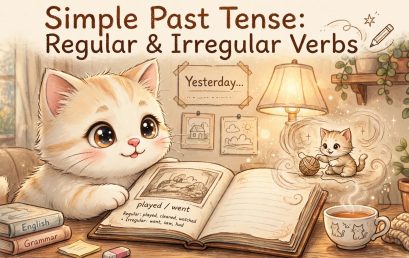
Simple Past Tense: Regular and Irregular Verbs
📚 English Grammar Series — Level 1: Beginner (Part 3 of 5) Want to tell stories about yesterday, last weekend, or your childhood? You need the simple past tense — the storyteller’s tense. It has two systems to learn: easy regular verbs (just add -ed) and irregular verbs (which change completely but are used constantly, […]
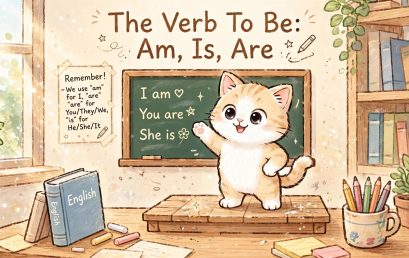
The Verb “To Be”: Am, Is, and Are Explained
📚 English Grammar Series — Level 1: Beginner (Part 2 of 5) The verb “to be” (am, is, are) is the single most-used verb in English — and unlike every other verb, it never needs a helper for negatives and questions. Learn it deeply once, and hundreds of everyday sentences become easy. 1. Am, Is, […]