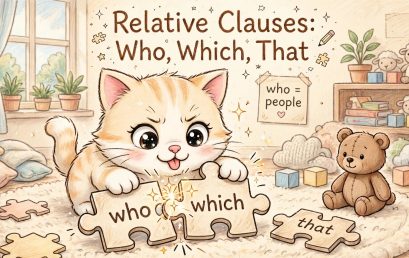
Relative Clauses: Who, Which, That, and Whose
📚 English Grammar Series — Level 3: Advanced (Part 2 of 3) Relative clauses are how English packs detail into sentences: “The teacher who helped me is very kind.” Instead of two choppy sentences, you get one smooth, elegant one. They’re also where tiny punctuation choices (a comma!) change meaning completely. Let’s go deep. 1. […]
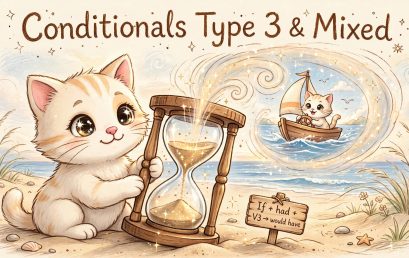
Conditional Sentences Type 3 & Mixed Conditionals
📚 English Grammar Series — Level 3: Advanced (Part 1 of 3) Welcome to advanced territory! Type 3 conditionals express the impossible past — regrets and what-ifs about things that already happened and can’t be changed. Mixed conditionals blend a past cause with a present result (or vice versa). Add wish / if only and […]
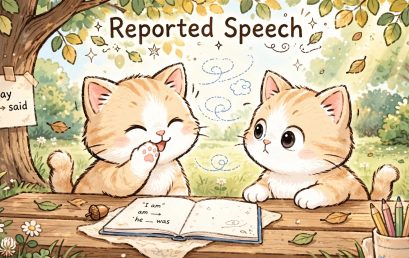
Reported Speech: Saying What Others Said
📚 English Grammar Series — Level 2: Intermediate (Part 5 of 5) She said, “I’m tired.” → She said she was tired. Reported speech (indirect speech) is how we retell what someone said — the grammar of storytelling, news reporting, and everyday gossip. The core mechanic is backshift: move the tense one step into the […]
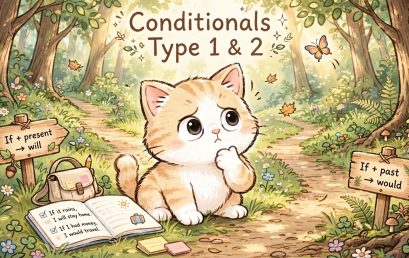
Conditional Sentences Type 1 & 2: Real and Unreal Situations
📚 English Grammar Series — Level 2: Intermediate (Part 4 of 5) “If it rains, I’ll stay home.” Conditional sentences connect a condition to its result — they’re how English expresses cause and effect, plans, dreams, and warnings. Types 1 and 2 handle the two most common situations: real possibilities and imaginary situations. (Type 0 […]

Modal Verbs: Can, Must, Should, Might, and More
📚 English Grammar Series — Level 2: Intermediate (Part 3 of 5) Can, could, must, should, may, might, will, would — modal verbs are the tiny engines of nuance in English: ability, permission, obligation, advice, possibility. One golden rule governs them all: after a modal, always use the base verb — no -s, no -ed, […]
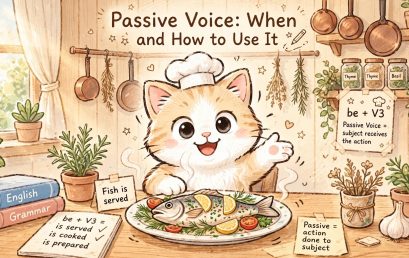
Passive Voice: When and How to Use It
📚 English Grammar Series — Level 2: Intermediate (Part 2 of 5) “Shakespeare wrote Hamlet” vs “Hamlet was written by Shakespeare” — same fact, different spotlight. The passive voice moves the receiver of the action to the front. It’s the voice of news, science, formal writing — and polite excuses. Let’s master every form of […]
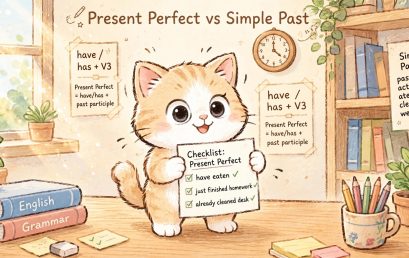
Present Perfect vs Simple Past: What’s the Difference?
📚 English Grammar Series — Level 2: Intermediate (Part 1 of 5) “I have eaten“ vs “I ate“ — both describe the past, so what’s the difference? This pair confuses almost every learner, but the logic is beautifully simple: simple past = finished time, present perfect = connection to now. Let’s break it down completely. […]
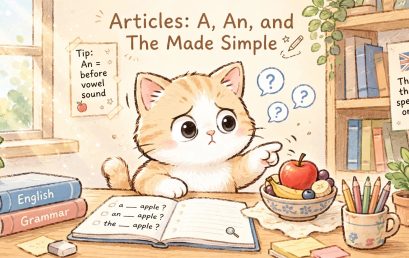
Articles: A, An, and The Made Simple
📚 English Grammar Series — Level 1: Beginner (Part 5 of 5) Three tiny words — a, an, the — cause more mistakes than almost any other grammar point. But there’s a clear logic: it’s all about whether your listener can identify which one you mean. Learn the system below and articles become predictable. 1. […]
