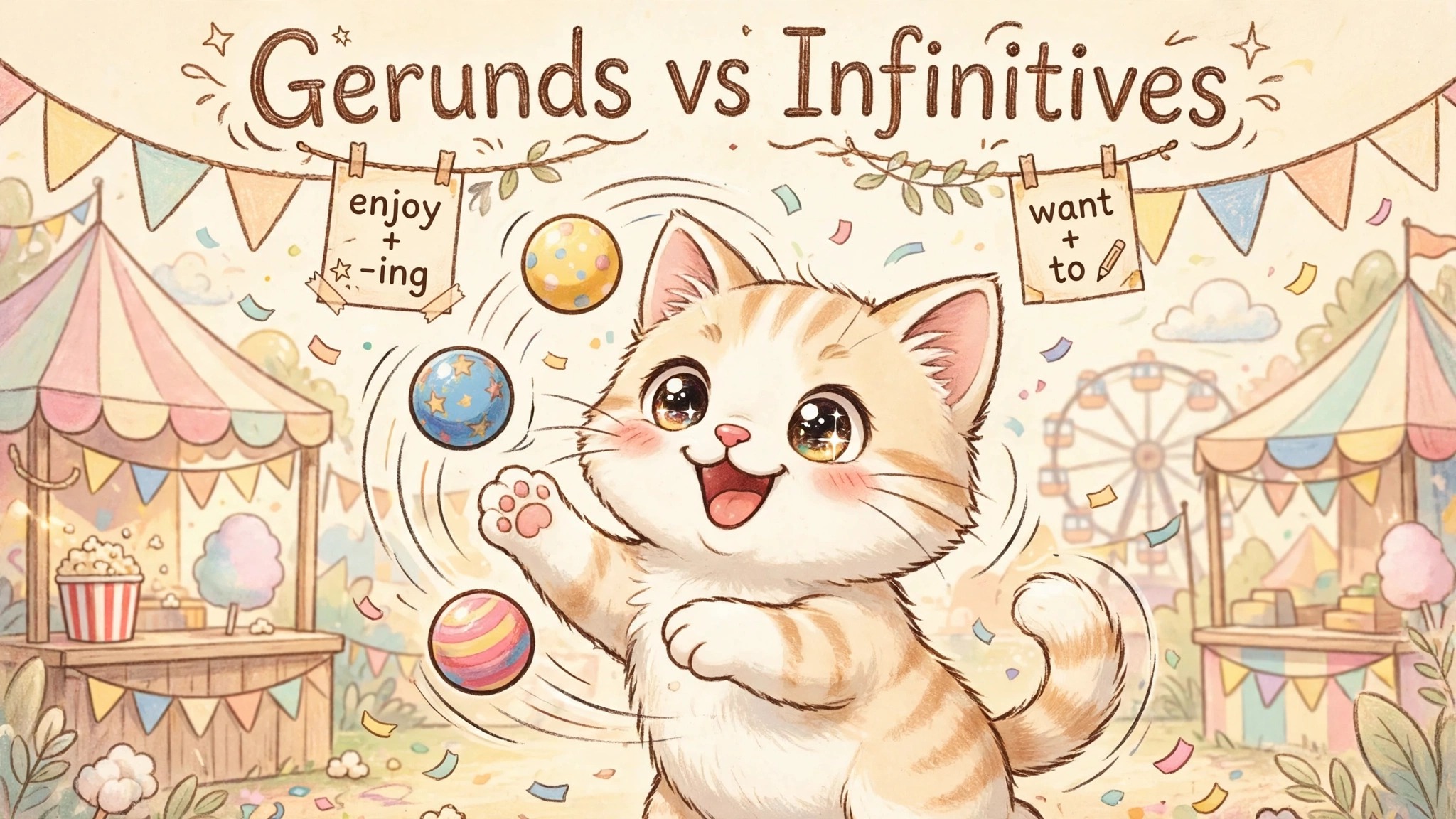
Gerunds vs Infinitives: Verb + Verb Patterns
📚 English Grammar Series — Level 3: Advanced (Part 3 of 3)
I enjoy reading. I want to read. Why does “enjoy” take verb-ing while “want” takes “to”? This is the gerund vs infinitive puzzle — one of the most tested patterns in TOEFL, IELTS, and university English. The secret? It’s not random: certain verbs simply demand certain patterns, and you learn them as fixed partnerships.
1. What’s What?
- Gerund = verb-ing acting as a noun: Swimming is fun. I enjoy reading.
- Infinitive = to + base verb: I want to swim. She decided to leave.
2. Verbs + Gerund — The Core List
Memorize these as partnerships: enjoy, finish, mind, suggest, avoid, practice, keep, consider, admit, deny, imagine, miss, risk, delay, fancy.
- I enjoy reading novels.
- She finished writing her thesis.
- Would you mind opening the window?
- He admitted taking the money.
- We should avoid driving at night.
After prepositions → ALWAYS gerund: I’m good at swimming. She left without saying goodbye. Thank you for coming. I’m interested in learning Japanese. This rule has no exceptions!
3. Verbs + Infinitive — The Core List
want, need, decide, plan, hope, expect, promise, agree, refuse, learn, seem, appear, afford, manage, offer, threaten.
- They decided to stay home.
- He promised to call back.
- We hope to visit next year.
- She can’t afford to buy a new car.
Verb + object + infinitive: want, ask, tell, advise, allow, expect, invite, persuade, remind, warn — She asked me to help. They persuaded him to stay.
4. The Famous Five — Same Verbs, Different Meanings!
| Verb | + Gerund (past / general) | + Infinitive (future / purpose) |
|---|---|---|
| remember | I remember posting the letter. (I did it — memory) | Remember to post the letter! (don’t forget — task) |
| forget | I’ll never forget meeting her. (memory) | Don’t forget to lock the door. (task) |
| stop | He stopped smoking. (quit the habit) | He stopped to smoke. (paused in order to smoke) |
| try | Try restarting your laptop. (experiment) | I tried to lift it, but it was too heavy. (attempt) |
| regret | I regret telling him. (sorry about the past) | We regret to inform you… (sorry about now) |
Two more: mean — It means working harder (involves) vs I meant to call (intended); go on — He went on talking (continued) vs He went on to become a doctor (next stage).
5. Both — No Meaning Change
begin, start, continue, like, love, hate, prefer, intend — It started raining / It started to rain. (both fine!) Small style note: after would like/love/prefer, use the infinitive: I’d like to go.
6. Infinitive of Purpose — “Why?”
Use to + verb to express purpose: She went to the market to buy fish. I study hard to pass the exam. (Never “for buy”!) Negative purpose: He woke up early not to miss the bus.
7. Common Mistakes
❌ I enjoy to read. → ✅ I enjoy reading.
❌ She decided staying. → ✅ She decided to stay.
❌ Would you mind to help me? → ✅ Would you mind helping me?
❌ I’m looking forward to see you. → ✅ …to seeing you. (“to” is a preposition here!)
❌ She went to market for buy fish. → ✅ …to buy fish.
🎯 Tip: learn them as chunks — “enjoy doing”, “decide to do”, “mind doing”, “look forward to doing”. Your brain stores phrases, not rules — so feed it phrases!
