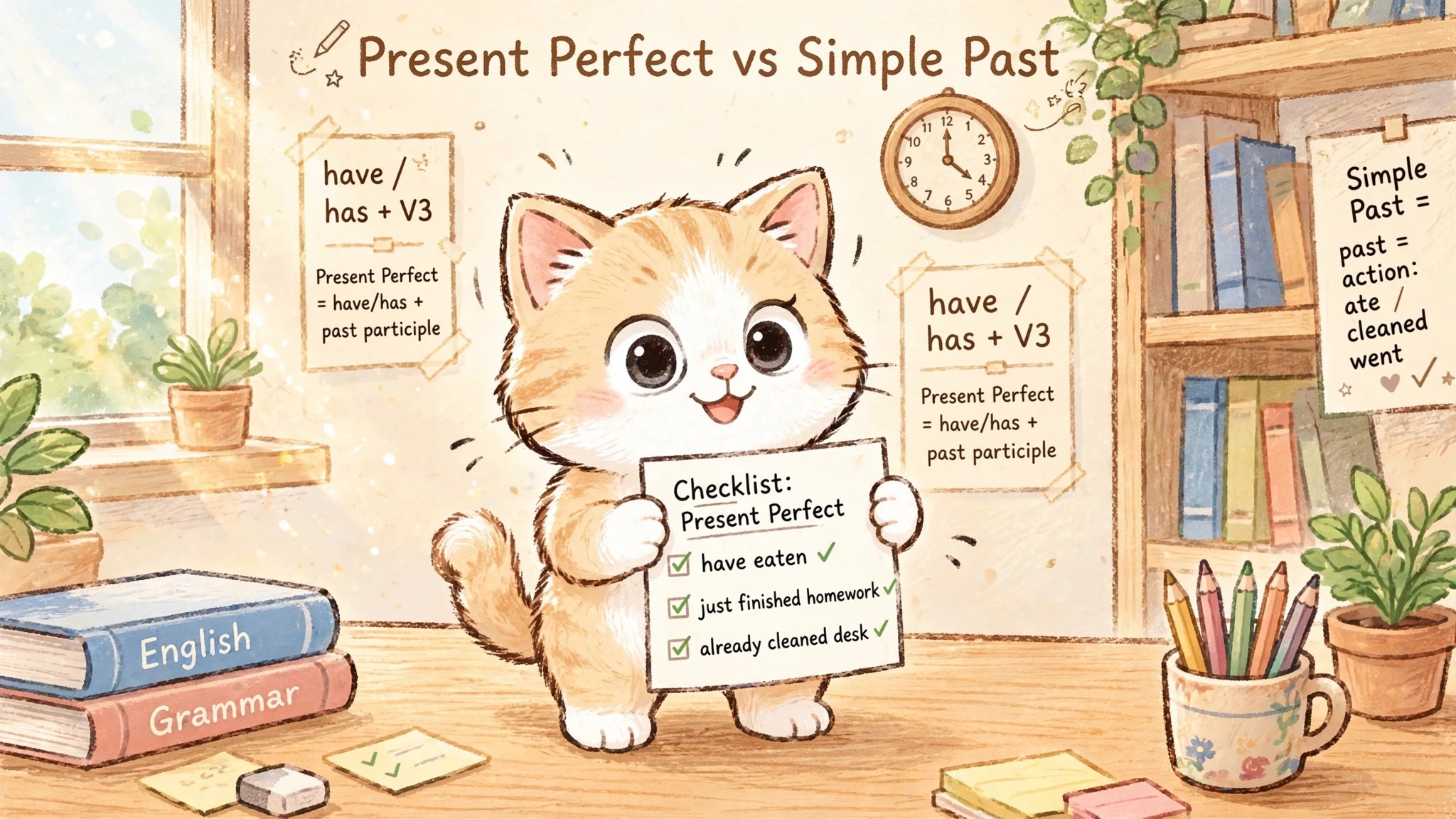
Present Perfect vs Simple Past: What’s the Difference?
📚 English Grammar Series — Level 2: Intermediate (Part 1 of 5)
“I have eaten“ vs “I ate“ — both describe the past, so what’s the difference? This pair confuses almost every learner, but the logic is beautifully simple: simple past = finished time, present perfect = connection to now. Let’s break it down completely.
1. The Core Difference
| Simple Past | Present Perfect | |
|---|---|---|
| Formula | verb-2: ate, went | have/has + verb-3: have eaten, has gone |
| Time | Finished: yesterday, in 2020 | Connected to now: just, already, ever |
| Example | I ate at 7. (7 o’clock is over) | I have eaten. (I’m full now) |
Past participles (verb-3) you must know: go → gone, eat → eaten, write → written, see → seen, do → done, take → taken, speak → spoken, break → broken, choose → chosen, forget → forgotten. (Same as the irregular past list, but the third column!)
2. Three Classic Uses of Present Perfect
a) Life experience (no specific time — the experience itself matters):
She has visited Japan twice. Have you ever tried durian?
b) Recent result affecting now:
Oh no! I have lost my keys. (= I don’t have them now)
He has just arrived. (= he’s here now)
c) Unfinished time periods:
I have read three books this month. (the month isn’t over — more may come)
She has worked here since 2020. (she still works here!)
3. Signal Words — Your Decision Helpers
| Present Perfect | Simple Past |
|---|---|
| just, already, yet, ever, never, recently, lately | yesterday, last night/week, in 2019, two days ago |
| since (point: since 2020) / for (duration: for 3 years) | — |
| this week/month/year (still ongoing) | that week / in May (finished) |
⚠️ Never mix finished-time words with present perfect: ❌ I have finished it yesterday. → ✅ I finished it yesterday. And ago is always simple past: three years ago.
4. Since vs For
- Since + starting point: since 2020, since Monday, since I was a child
- For + length of time: for three years, for a week, for a long time
- She has lived here since 2019 / for seven years.
5. Bonus: Present Perfect Continuous
For actions that started in the past and are still continuing (emphasis on duration): have/has been + verb-ing. I have been studying for three hours. vs I have studied three chapters. (duration vs result). Common with since/for, all day, lately.
6. Common Mistakes
❌ I have seen him yesterday. → ✅ I saw him yesterday.
❌ Did you ever eat sushi? → ✅ Have you ever eaten sushi?
❌ She has went home. → ✅ She has gone home.
❌ I have lived here since five years. → ✅ …for five years.
❌ He has arrived three days ago. → ✅ He arrived three days ago.
🎯 Tip: the one-second test — “does the time still touch the present?” If yes → present perfect. If the time is sealed in the past → simple past.
