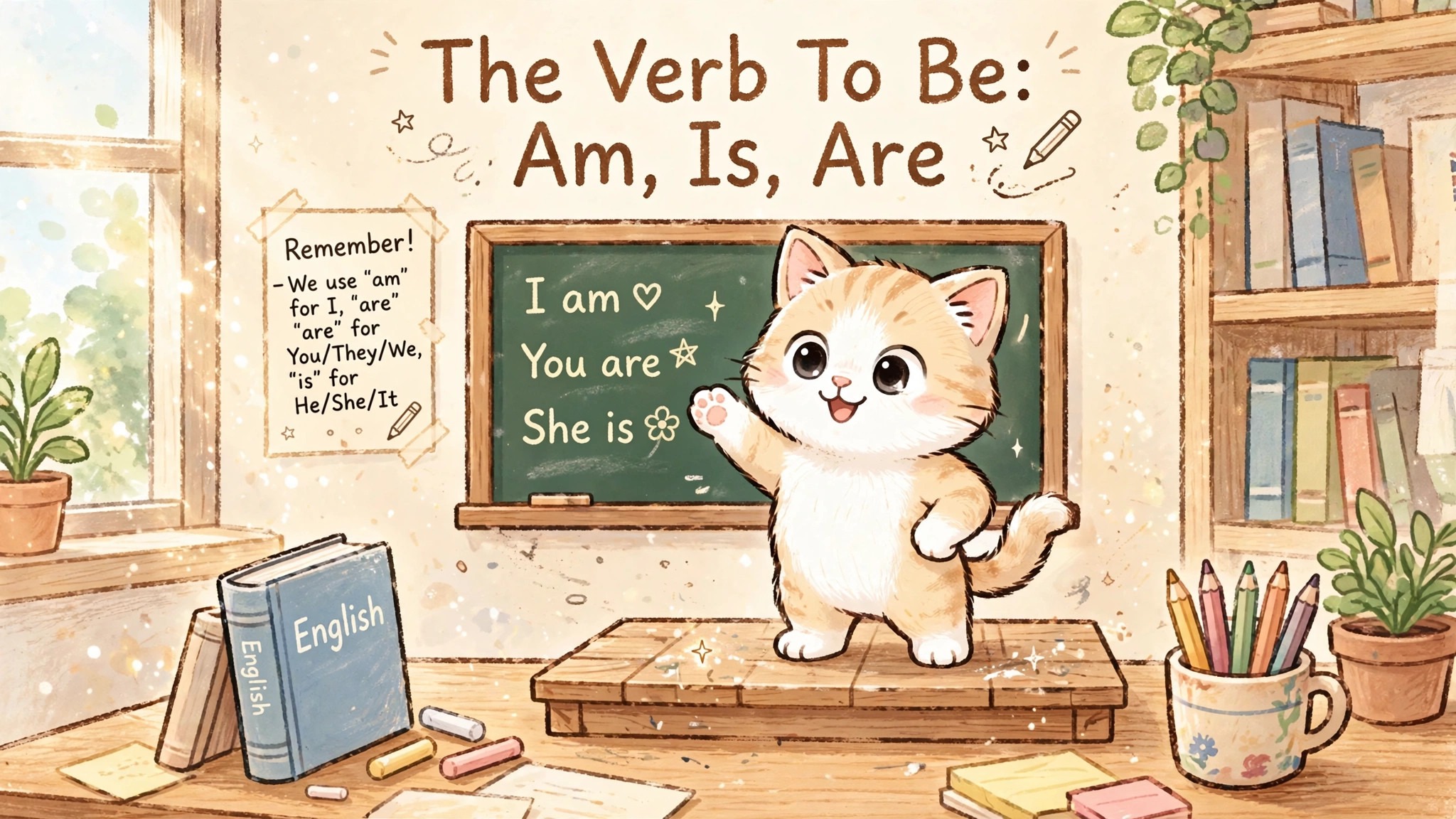
The Verb “To Be”: Am, Is, and Are Explained
📚 English Grammar Series — Level 1: Beginner (Part 2 of 5)
The verb “to be” (am, is, are) is the single most-used verb in English — and unlike every other verb, it never needs a helper for negatives and questions. Learn it deeply once, and hundreds of everyday sentences become easy.
1. Am, Is, Are — Matching the Subject
| Subject | Form | Example |
|---|---|---|
| I | am (‘m) | I am a student. |
| He / She / It | is (‘s) | She is tired. |
| You / We / They | are (‘re) | They are my friends. |
Contractions (used in almost all spoken English): I’m, you’re, he’s, she’s, it’s, we’re, they’re — and negatives: isn’t (= is not), aren’t (= are not), I’m not. Note: there is no “amn’t” — say I’m not!
2. Six Jobs of “To Be”
- Identity / introduction: I am Galih. This is my sister.
- Description: The cat is cute. They are tall.
- Feelings and states: I am happy. He is nervous about the exam.
- Age: I am 25 years old. ⚠️ Never say “I have 25 years” — that’s a classic translation mistake!
- Jobs: She is a doctor. They are engineers.
- Location: We are at home. The keys are on the table.
3. There Is / There Are — Saying Something Exists
To say something exists, use there is (singular) / there are (plural):
- There is a cat on the roof.
- There are three books on my desk.
- Is there a bank near here? / There isn’t any milk left.
4. Negatives and Questions — No Helper Needed!
“To be” moves by itself — never use do/does with it:
- Negative: just add not → I am not ready. She isn’t here. They aren’t late.
- Yes/no question: swap subject and verb → Am I late? Is she your sister? Are you okay?
- Wh-question: Where are you from? How old is he? What is this?
5. A Peek at the Past: Was / Were
You’ll meet these constantly, so learn them now: I/he/she/it → was, you/we/they → were. I was sick yesterday. They were at the mall last night. (Full lesson in Simple Past!)
6. Common Mistakes
❌ I is a student. → ✅ I am a student.
❌ They is happy. → ✅ They are happy.
❌ Do you are ready? → ✅ Are you ready? (no “do” with “be”!)
❌ She not is tired. → ✅ She is not tired.
❌ I have 20 years old. → ✅ I am 20 years old.
❌ There is many people here. → ✅ There are many people here.
🎯 Tip: introduce yourself in English every morning — “I’m…, I’m … years old, I’m a…” — and “to be” will become automatic within a week.
