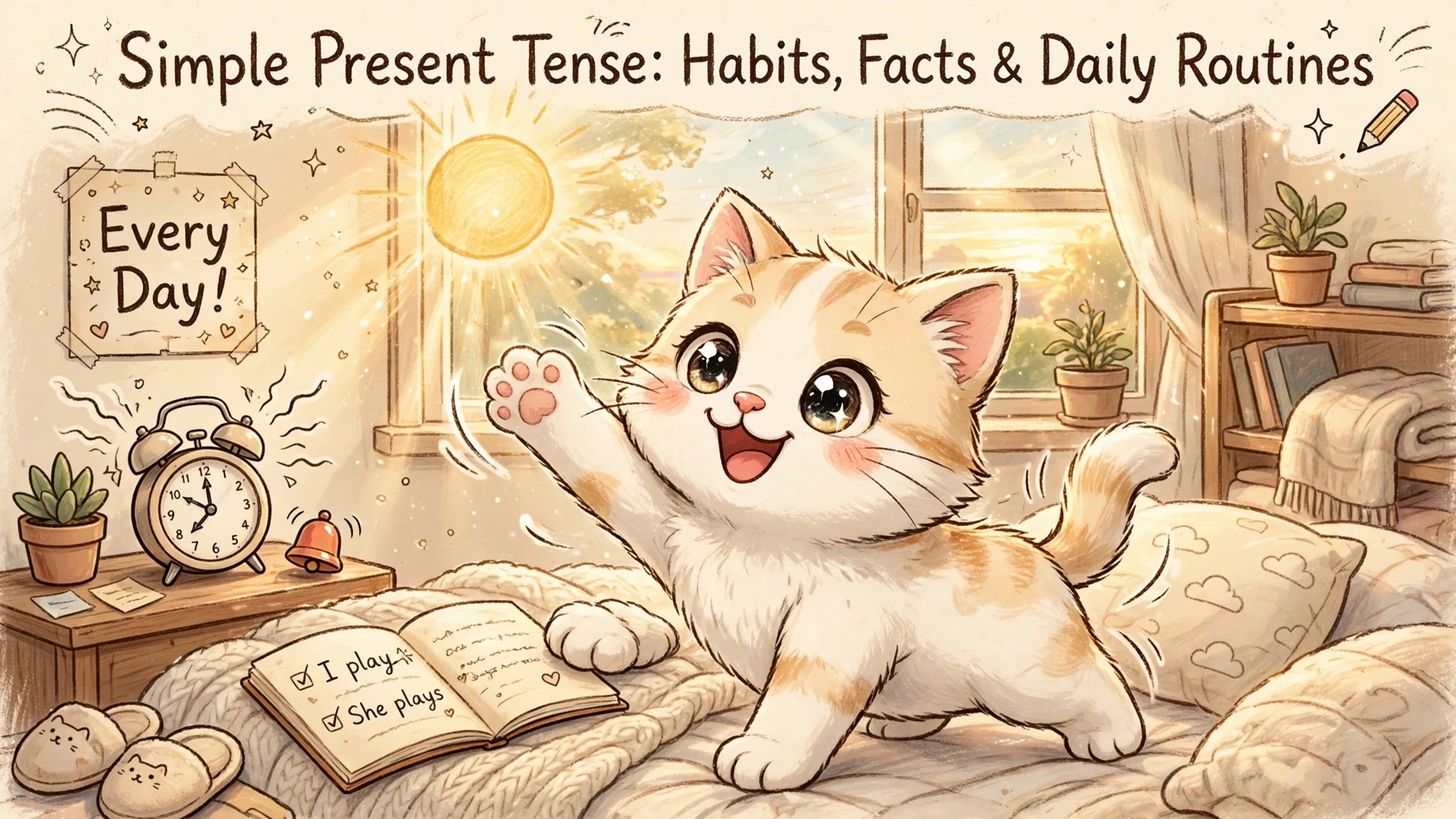
Simple Present Tense: Habits, Facts, and Daily Routines
📚 English Grammar Series — Level 1: Beginner (Part 1 of 5)
The simple present tense is the backbone of everyday English. We use it far more often than learners expect — not just for “present” things, but for habits, routines, facts about the world, schedules, and even opinions and feelings. Master this tense and you can already hold a real conversation about your life.
1. When Do We Use It?
a) Habits and routines — things you do regularly:
I drink coffee every morning. She goes jogging twice a week.
b) General truths and facts — things that are always true:
Water boils at 100°C. The sun rises in the east.
c) Schedules and timetables — even for the future, when it’s a fixed schedule:
The class starts at 8 a.m. The train leaves at 6:30.
d) Feelings, opinions, and states — with “state” verbs like love, hate, know, want, believe:
She loves cats. I think you’re right. They want a new car.
2. The -s Rule for He / She / It
For I, you, we, they → use the base verb: I work, they play.
For he, she, it → add -s (with spelling rules):
| Rule | Example |
|---|---|
| Most verbs → add -s | play → plays, read → reads |
| Verbs ending in -s, -sh, -ch, -x, -o → add -es | watch → watches, go → goes, fix → fixes |
| Consonant + y → change y to -ies | study → studies, fly → flies |
| Vowel + y → just add -s | play → plays, enjoy → enjoys |
| Irregular | have → has |
3. Frequency Adverbs — Where Do They Go?
Words like always, usually, often, sometimes, rarely, never describe how often — and they sit before the main verb but after “be”:
- I always brush my teeth before bed.
- She usually takes the bus to campus.
- They never eat breakfast.
- He is always late! (“be” + adverb)
Frequency scale: always (100%) → usually → often → sometimes → rarely → never (0%).
4. Negatives and Questions with Do / Does
For action verbs, do/does is the helper. Golden rule: after “does”, the main verb loses its -s!
- Negative: I don’t like tea. She doesn’t like tea.
- Question: Do you speak English? Does he speak English?
- Short answers: Do you like coffee? — Yes, I do. / No, I don’t. / Does she work here? — Yes, she does.
- Wh-questions: Where do you live? What does she do?
5. Common Mistakes
❌ He don’t like cats. → ✅ He doesn’t like cats.
❌ Does she works here? → ✅ Does she work here? (no -s after “does”!)
❌ She go to school by bus. → ✅ She goes to school by bus.
❌ I never am late. → ✅ I am never late. (adverb after “be”)
❌ They doesn’t play football. → ✅ They don’t play football.
🎯 Tip: describe your entire daily routine out loud in the simple present — “I wake up, I brush my teeth, I go to campus…” — it’s the fastest way to make this tense automatic.
