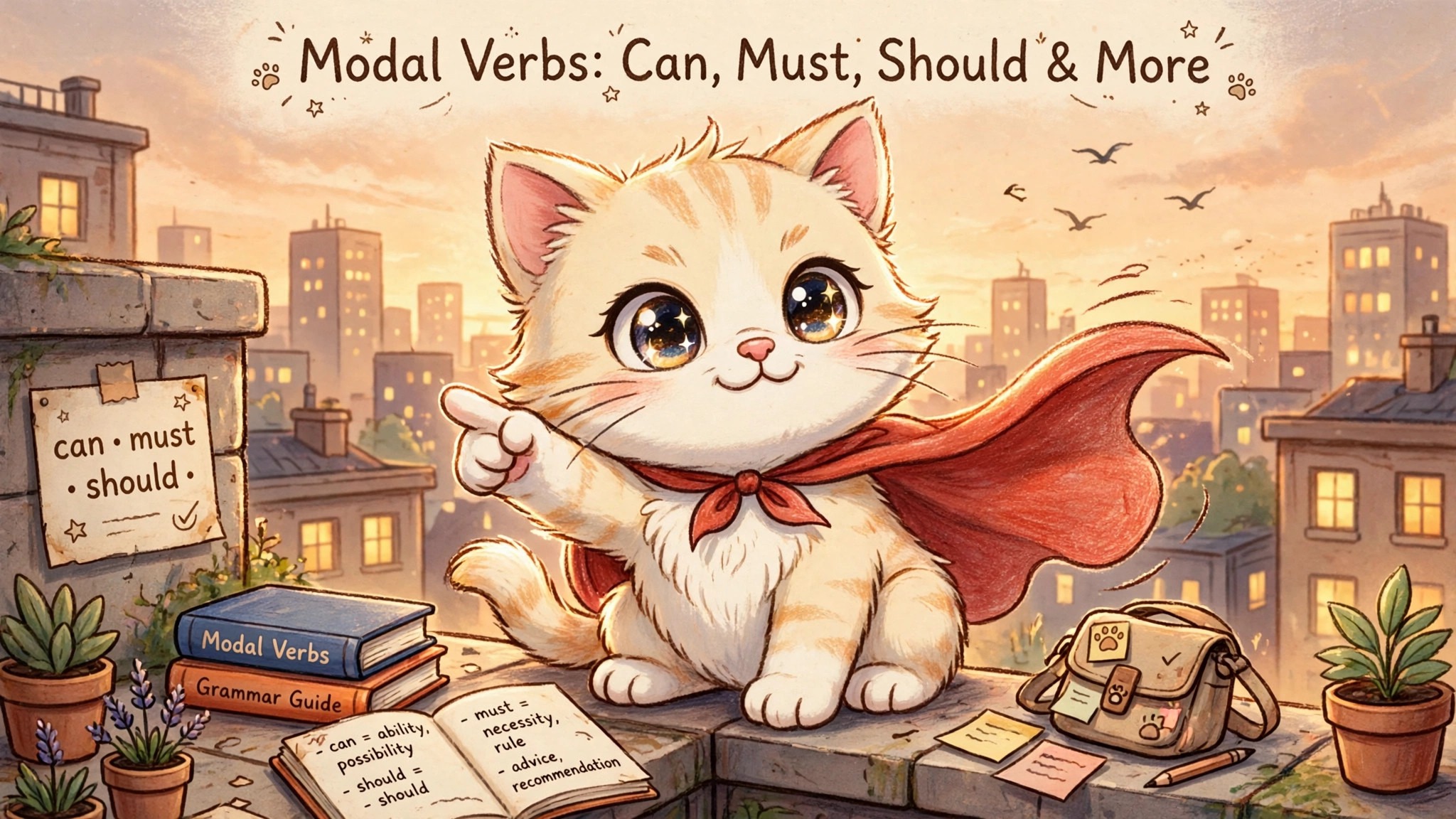
Modal Verbs: Can, Must, Should, Might, and More
📚 English Grammar Series — Level 2: Intermediate (Part 3 of 5)
Can, could, must, should, may, might, will, would — modal verbs are the tiny engines of nuance in English: ability, permission, obligation, advice, possibility. One golden rule governs them all: after a modal, always use the base verb — no -s, no -ed, no -ing, no “to”. Let’s go modal by modal.
1. Ability & Permission: Can / Could / Be Able To
- Can — present ability / informal permission: She can swim. Can I borrow your pen?
- Could — past ability: He could read at age four. / polite request: Could you help me? (more polite than “can”)
- Be able to — the flexible alternative (works in all tenses!): I will be able to come tomorrow. She has been able to swim since childhood.
⚠️ Could vs was able to (one specific past achievement): He was able to escape the fire. (specific event — “could” sounds odd here!) But for general past ability: He could run fast when he was young.
2. Obligation: Must / Have To / Need To
- Must — strong obligation, often the speaker’s own decision: I must study harder.
- Have to — obligation from outside rules (more common in speech, works in all tenses): I have to wear a uniform. She had to leave early.
- Need to — necessity: You need to rest.
The negative trap (they mean totally different things!):
You mustn’t smoke here. = prohibition! (don’t do it)
You don’t have to come. = it’s optional (no obligation)
You don’t need to hurry. = not necessary
3. Advice: Should / Ought To / Had Better
- Should — general advice: You should see a doctor.
- Ought to — slightly more formal “should”: You ought to apologize.
- Had better — strong advice with a warning: You’d better hurry, or you’ll miss the bus!
4. Possibility — The Certainty Scale
From most to least certain: will → must (logical deduction) → should → may → might → could
- He must be tired. (I’m quite sure — logical conclusion)
- It should arrive by Friday. (I expect so)
- It may/might rain later. (possible — “might” is slightly less certain than “may”)
5. Past Modals — Judging the Past
Modal + have + past participle — for regrets, deductions, and criticism about the past:
- You should have studied harder. (regret — but you didn’t)
- He must have forgotten. (deduction about the past)
- She could have won. (past possibility that didn’t happen)
- They might have left already. (maybe — I’m not sure)
6. Common Mistakes
❌ She can sings well. → ✅ She can sing well.
❌ You must to hurry. → ✅ You must hurry.
❌ He cans drive. → ✅ He can drive. (modals never take -s!)
❌ You don’t must smoke. → ✅ You mustn’t smoke.
❌ It must to rain. → ✅ It might rain.
🎯 Tip: modals are always followed by the base verb — tattoo this rule in your brain and half of all modal mistakes disappear forever.
