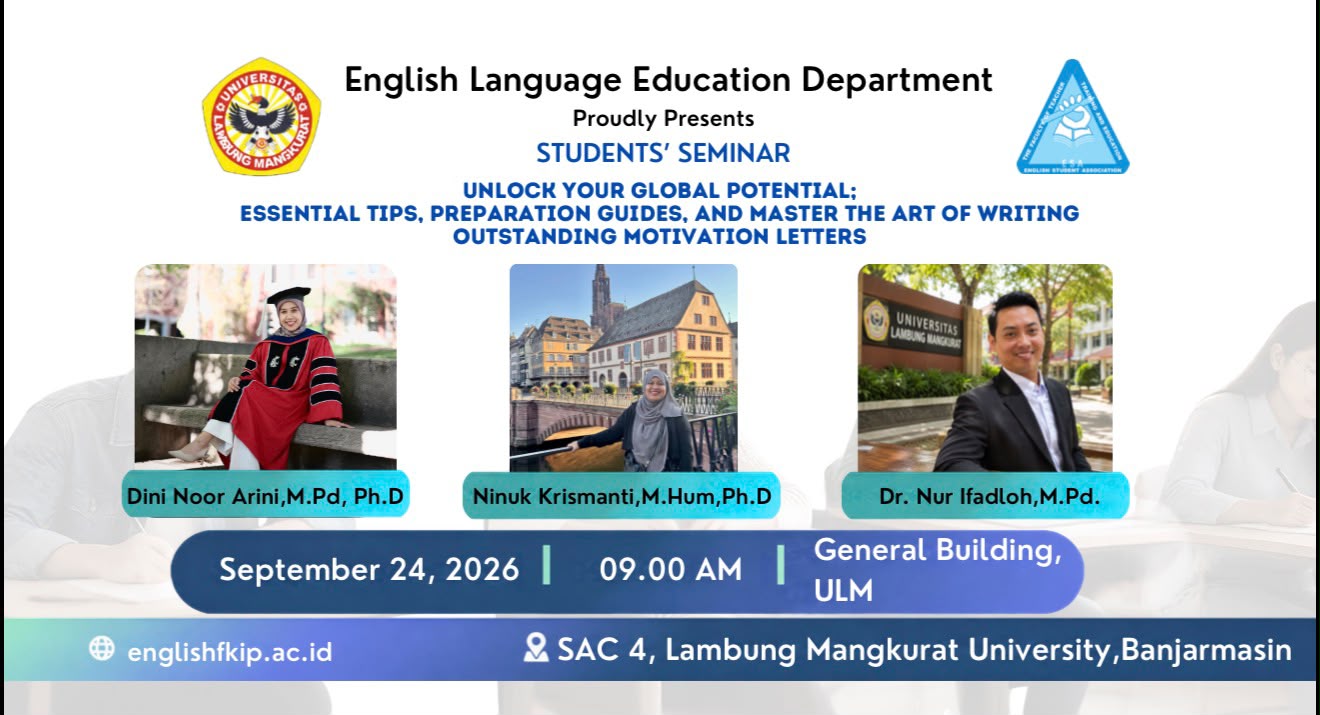
Students’ Seminar: Unlock Your Global Potential — Tips on Motivation Letters and Scholarship Preparation
Banjarmasin — The English Language Education Department of Universitas Lambung Mangkurat held a Students’ Seminar titled “Unlock Your Global Potential: Essential Tips, Preparation Guides, and Master the Art of Writing Outstanding Motivation Letters” on September 24, 2026, at the General Building, ULM.
The seminar featured three speakers — Dini Noor Arini, M.Pd., Ph.D., Ninuk Krismanti, M.Hum., Ph.D., and Dr. Nur Ifadloh, M.Pd. — who guided students through going global, building cross-cultural competence, and crafting competitive scholarship applications.
The Art of the Motivational Letter
Dini Noor Arini opened with a key reframing: a motivational letter is not a biography, and not your CV rewritten in sentences — it is your argument: why your experiences, goals, and the opportunity make sense together. “The question is not only what have you done? but what does it mean?“
She introduced five questions every strong letter must answer: Who are you? (what shaped you), Why this? (why this field or opportunity), Why you? (evidence of readiness), Why here? (why this specific program), and What next? (what you will do with the opportunity).
On writing technique, she stressed “show, don’t tell” — replacing empty claims like “I am passionate about education” with concrete moments and evidence — and shared a clear six-part structure: Opening, Journey, Evidence, Fit, Future, and Closing. Addressing AI, she reminded students: “AI can polish your English. It should not invent your identity.” Use AI for clarity and grammar, she advised — but your experiences come first.
Unlocking Global Opportunities
Ninuk Krismanti mapped the many pathways to go global, reminding students that studying abroad is not the only route: student exchanges, short courses, research and international internships, volunteer programmes, master’s and doctoral degrees, international conferences and competitions, and scholarships such as LPDP, Australia Awards, Fulbright, and Gates Cambridge.
She introduced cross-cultural understanding — the ability to understand, respect, and effectively engage with people from different cultural backgrounds (Deardorff, 2006) — built on cultural awareness, active listening, respect and empathy, and effective communication. She closed with Seneca’s words: “Luck is what happens when preparation meets opportunity.”
From Dream to Application
Dr. Nur Ifadloh presented a seven-stage roadmap from dream to impact: Dream → Discover → Build → Prepare → Apply → Interview → Impact. A competitive candidate, he explained, is not only about high GPA or many certificates — it is the combination of academic readiness, leadership, community impact, clear purpose, and a coherent, authentic personal story.
He introduced the five pillars of a strong profile — academic achievement, leadership, contribution, professional experience, and global readiness — and the STAR + Future framework (Situation, Task, Action, Result, Future) for telling one’s story with evidence. He also detailed English proficiency requirements for major scholarships (LPDP, Fulbright/AMINEF, Chevening, Australia Awards, BIB) and the complete document portfolio applicants need, with a firm reminder: “Don’t wait for the scholarship opening to prepare your documents.” He closed with a call to action: “Dream. Prepare. Believe. Apply. Impact.”
The seminar equipped students with practical, immediately usable strategies — from writing an honest, reflective motivation letter to building a scholarship-ready profile long before deadlines arrive.
